Gee Dev

Linkedin
Instagram
Gmail
GitHub
Scholar
CV
Research Thesis · 2025–2026
AURA - Adaptive User-Responsive Architecture

AURA - Adaptive User-Responsive Architecture

A calibration-first, telemetry-driven behavioural modelling and neuro-fuzzy surrogate framework for real-time procedural environment adaptation in games.

ADScAI 2026 · Top 7 of 200+ Submissions
Demo Live Dashboard GitHub Thesis PDF
ThesisAURA: Real-Time Environment Adaptation Using Neuro-Fuzzy Procedural Content Generation
RoleSole Researcher & Developer
InstituteUniversity of Westminster, UK
SupervisorMr. Banu Athuraliya
0.9264
Test R²
threshold 0.90 ✓
0.0127
Test MAE
1.6% of output range
6→16→8→1
MLP Architecture
ReLU hidden · linear output
0.8600
Train R²
MAE = 0.0139
0.9264
Test R²
threshold 0.90 ✓
0.0127
Test MAE
1.6% of output range
6→16→8→1
MLP Architecture
ReLU hidden · linear output
0.8600
Train R²
MAE = 0.0139
43
Unit Tests
22 suites · 7 files · All Pass
OVERVIEW

Background

Project Overview

Static, hand-crafted environments fail to respond to the wide spectrum of player behavioural styles, resulting in sub-optimal engagement for players who do not fit the assumed archetype.

AURA solves this through a calibration-first pipeline that establishes a neutral behavioural baseline from real player data, then models player behaviour using unsupervised clustering and soft fuzzy membership, and deploys a lightweight neural surrogate model via a decoupled backend to drive real-time procedural adaptation in Unreal Engine 5.

The framework spans three public GitHub repositories: a Python data science pipeline, a Node.js/TypeScript backend, and a Blueprint-integrated Unreal Engine 5 prototype with a Next.js analytics dashboard.

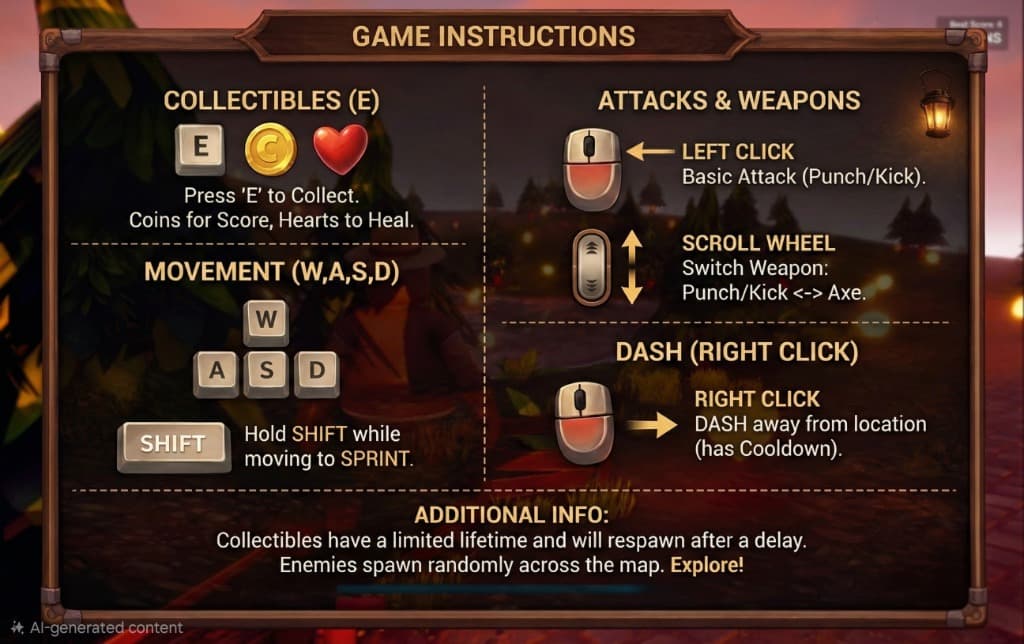
AURA Gameplay Instructions
ARCHITECTURE

System Design

Three-Phase Architecture

1

Phase 01

Calibration

CollectGame.CalibrationAnalysis
Seven participants played a custom-built game (CollectGame) across three game modes in a within-subjects randomised design. A NeutralityScore metric (weighted composite of sparsity, death rate, and standard deviation) identified Mode 1 as the neutral baseline environment. Calibration artefacts — centroids, scaler parameters, and initial multiplier — are frozen permanently and never retrained with adaptive data, preserving the integrity of the behavioural reference.

Primary Artefact

neutral baseline (Mode 1), initial_parameters.json, scaler_params.json, centroids.json
01
2

Phase 02

Behavioural Modelling & Model Construction

CollectGame.Model
A Python pipeline across 18 notebooks (10 core + 1 independent analysis + 7 ablation experiments) processed 45 filtered players across 3,240 30-second telemetry windows using a 12-feature schema (10 raw + 2 derived: damage_per_hit and pickup_attempt_rate). K-Means clustering (K=3, silhouette score = 0.4948) identified three behavioural archetypes: Combat, Exploration, and Collection; window distribution: Combat = 744, Collection = 989, Exploration = 1,507. Soft membership is computed via Inverse Distance Weighting (IDW) against cluster centroids. An ANFIS model was trained offline, and an MLP surrogate (architecture 6→16→8→1, ReLU hidden layers, linear output) achieved Test R² = 0.9264 and Test MAE = 0.0127 — comfortably exceeding the 0.90 threshold. Data split: 68.2% train (2,159 samples) / 15.5% val (491) / 16.2% test (514).

Primary Artefact

anfis_mlp_weights.json, scaler_params.json, centroids.json, mlp_neutral = 0.932000

02
3

Phase 03

Backend Integration & Real-Time Inference

CollectGame.Telemetry
A Node.js/TypeScript backend on Render implements the full inference pipeline: telemetry normalised → archetype activity scores → IDW soft membership → window-to-window behavioural deltas → 6-dimensional state vector into MLP surrogate → neutral-centred calibration → multiplier clamped to [0.6, 1.4]. 90-second session-state persistence prevents cold-start spikes. A forward-only constraint ensures multipliers affect only future PCG content. MLP inference latency 45.53 µs (< 1ms); full backend round-trip under 200ms on Render's free tier.

Primary Artefact

Live adaptation multiplier per 30-second window

03

Pipeline flows Phase 01 → 02 → 03

TECHNOLOGY

Stack

Technology Stack

Data Science & ML

PythonJupyter NotebooksNumPyPandasScikit-learnK-Means ClusteringANFIS (Neuro-Fuzzy)MLP Neural NetworkMinMaxScalerIDW Soft Membership

Backend & Infrastructure

Node.jsTypeScriptExpress.jsREST APIMVC + Repository + ServiceMongoDBRender

Frontend & Game Engine

Next.js 14ReactRechartsVercelUnreal Engine 5.3Blueprint (UE5)VaRest PluginVitest
SHOWCASE

Demo

Video Showcase

Prototype Demo

Live gameplay demonstration of the AURA adaptive system running in Unreal Engine 5, showing real-time procedural environment changes driven by player behavioural telemetry.

Research Presentation

Full academic presentation of the AURA framework covering the research problem, three-phase architecture, experimental results, and evaluation findings.

Gameplay Reference

Raw Gameplay B-Roll (Muted)

Uncut gameplay sequence starting at 8:15, demonstrating real-time procedural and environmental adaptation.

Live System Interface

Next.js dashboard · Deployed on Vercel

A publicly accessible dashboard exposing the full AURA inference pipeline — real-time behavioural membership weights (Combat / Collection / Exploration), adaptation multiplier time-series, and per-window session logs with validation indicators.

Open Dashboard
RESEARCH

Academic Output

Published Research Paper

ADScAI 2026 · University of Moratuwa, Sri Lanka

Real-Time Environment Adaptation Using Telemetry-Driven Behavioural Clustering and Neuro-Fuzzy Procedural Content Adaptation

K. W. J. Pasindu Geevinda, Banuka Athuraliya

Accept (Oral)

Top 7 of 200+ Submissions

Selected among the best seven from over 200 submissions to ADScAI 2026 at University of Moratuwa.

Abstract

Dynamic Difficulty Adjustment (DDA) systems attempt to keep players engaged by varying the difficulty of the game in response to observed behaviour. Most current methods initiate adaptation immediately, resulting in cold-start bias, erratic early behaviour, and reduced interpretability. To overcome these limitations while maintaining player agency and behavioural validity, this paper presents a calibration-first, telemetry-driven adaptive game framework. Before any intervention, the system creates a statistically neutral behavioural reference by clearly separating the initial calibration from real-time adaptation. Soft membership across combat, exploration, and collection archetypes is used to model player behaviour while capturing behavioural fluidity without strict categorisation. An explainable ANFIS-inspired neuro-fuzzy reasoning formulation processes these representations with temporal deltas to generate bounded, forward-looking difficulty adjustments. Stable adaptation is ensured and oscillatory feedback is avoided through temporal smoothing and safety constraints. Empirical evaluation confirms the MLP surrogate approximates ANFIS-inspired teacher targets with 92.6% explained variance (R² = 0.9264), and that removing temporal behavioural signals collapses this fidelity by 38 percentage points, providing a principled foundation for reliable real-time adaptive gameplay.

Key Contributions

C01

Calibration-First Methodology

Framework that explicitly separates baseline calibration from real-time adaptation to eliminate cold-start bias and feedback contamination.

C02

Soft Behavioural Modelling

Soft clustering captures behavioural fluidity without forcing players into strict, rigid categorizations.

C03

Explainable Neuro-Fuzzy Control

Forward-looking neuro-fuzzy reasoning layer (approximated by a runtime MLP) ensures stable, interpretable, and trustworthy adaptation.

C04

Constrained Control for Player Agency

Bounded multipliers and temporal smoothing avoid oscillatory feedback and preserve player agency throughout adaptation.

Applied computing → Computer gamesComputing methodologies → Artificial intelligence · Machine learning · Fuzzy logic
Read Paper (OpenReview) View Google Scholar Profile
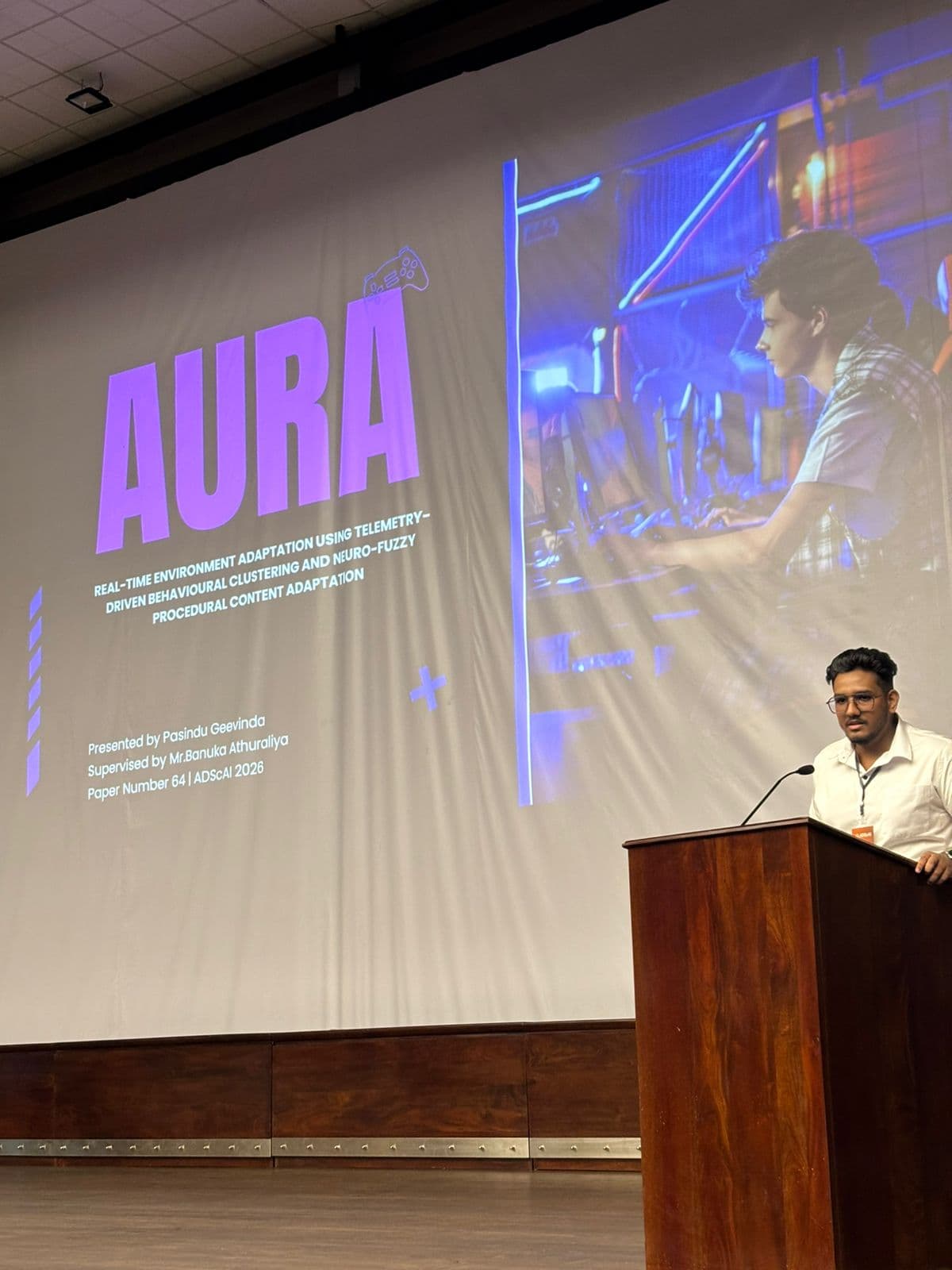
Oral presentation at ADScAI 2026 — selected among top 7 papers

Oral presentation · ADScAI 2026

DATASET

Open Data

Open Source Dataset

Kaggle · Published Dataset

Game Telemetry & Player Archetype Modeling (AURA)

DOI: 10.34740/KAGGLE/DSV/15614101CC BY-SA 4.0
View on KaggleCite via DOI
3,240
Telemetry Windows
30 seconds each
45
Player Sessions
≥20 min session filter
69
Registered Players
→ 64 complete → 45 retained
CSV + JSON
File Formats
Raw & Processed pipelines
Anonymized player telemetry data extracted from AURA, a custom 3D third-person video game. Collected to model and classify Player Archetypes based on in-game behavior, measuring Combat, Exploration, and Collection playstyles over active gameplay sessions. All PII has been strictly scrubbed to guarantee anonymity.
FormatsCSVJSON
FEATURES

Design

System Highlights

  • Calibration-first design

    Neutral baseline established from real player data before any adaptive logic activates; calibration artefacts are immutable and never retrained.

  • Soft behavioural membership

    IDW-based fuzzy membership replaces hard cluster assignment, giving smooth, proportional archetype representations across all windows.

  • Temporal delta signals

    Window-to-window membership change vectors capture behavioural momentum rather than relying solely on instantaneous snapshots.

  • Surrogate inference

    MLP surrogate approximates the full ANFIS reasoning surface at < 1ms, making real-time deployment feasible without running full fuzzy inference in the game loop.

  • Engine-agnostic decoupled backend

    The inference pipeline runs entirely outside the game engine via HTTP REST — portable to any engine that supports HTTP calls.

  • Forward-only adaptation

    Multipliers affect only future procedurally generated content, preserving player agency and preventing retrospective world modification.

  • Bounded adaptation

    All multipliers clamped to [0.6, 1.4]; 90-second session-state persistence prevents cold-start spikes and abrupt environmental shifts.

  • Full observability dashboard

    Real-time Next.js dashboard shows membership weights, multiplier time-series, and per-window session logs with validation indicators.

  • Delta-signal ablation

    Removing temporal delta inputs collapses surrogate fidelity 3.7× (MAE: 0.0127 → 0.0478), confirming that behavioural momentum — not just instantaneous archetype state — is essential for accurate multiplier prediction.

EVALUATION

Validation

Evaluation Summary

The system was evaluated by 9 industry practitioners spanning two panels — 5 Domain Experts and 4 Technical Experts — using structured Google Meet sessions, written responses, and thematic analysis of qualitative feedback.

Evaluation evidence is documented in Appendix L & E of the thesis.

Evaluation Criteria

  1. 01Overall concept and novelty of the research
  2. 02Scope, depth, and complexity of the solution
  3. 03Design and architectural decisions
  4. 04Implementation quality and technical efficiency
  5. 05Adaptive stability and behavioural alignment
  6. 06Limitations and future improvement directions

Domain Experts

Real-world applicability, player experience relevance, and product viability.

Technical Experts

Architectural soundness, inference pipeline design, and code quality.

End-User Observations

Qualitative playtester feedback from structured focus group sessions.
LINKS

Resources

Links & Resources

Media

Prototype DemoResearch PresentationLive Dashboard

Source Code

Phase 1 — CalibrationPhase 2 — Model + DashboardPhase 3 — Telemetry Backend

Research Outputs

Open Dataset (Kaggle · DOI)University Thesis (PDF)

Thesis · IIT Sri Lanka / University of Westminster, 2026

AURA: Real-Time Environment Adaptation Using Neuro-Fuzzy Procedural Content Generation with Behavioural Clustering

Dataset DOI: 10.34740/KAGGLE/DSV/15614101

Read Full Thesis (PDF)